


Software auditability is not a paperwork exercise. It is the operational proof that lets developers, security teams, and decision-makers understand what code shipped, who had access, how data moved, and whether the system behaved as intended. In the RAD Studio context, that makes software auditability a strong positioning lens: the platform helps teams build native, connected, data-rich applications that are not only fast to deliver, but also easier to govern, explain, and trust.
Security failures usually begin with uncertainty
Security incidents rarely start with a dramatic headline like “the encryption failed.” More often, the first real problem is that nobody can say what actually happened. Frequently, incidents accompany a breakdown in seemingly innocuous procedure: the inability to find what code was changed, often hand in hand with not knowing who changed it. This can be compounded with a lack of understanding about what was deployed, which account touched a sensitive record, or why a transaction behaved the way it did. When that evidence is missing, incident response slows down, root-cause analysis gets fuzzy, and compliance turns into a scramble.
That is why auditability belongs in the security architecture itself. It is not a compliance appendix and it is not paperwork for later. It is the discipline of making systems explainable. For app developers, that means building software that produces usable evidence at the build layer, the access-control layer, the service layer, and the data layer.
This matters especially for the kinds of applications many teams build with RAD Studio: business-critical desktop systems, mobile applications with local data, connected middle tiers, and long-lived enterprise software that must survive audits, upgrades, and staffing changes over many years. In that environment, security is not only about blocking bad actors. It is about traceability, maintainability, controlled change, and the ability to prove what your software is doing over time.
Why software auditability is not paperwork
Audit trails are often treated as logs for auditors. That is too narrow. In practice, auditability is how security teams detect abnormal behavior, how engineering teams reconstruct incidents, and how decision-makers reduce operational risk. A weak audit trail does not just create compliance friction. It creates blind spots.
If your organization cannot quickly answer basic questions about builds, deployments, access decisions, data movement, or privileged actions, the business pays for that uncertainty in three ways. Incidents take longer and cost more to investigate. Fixes become less precise because teams patch symptoms instead of causes. And audit preparation burns senior engineering time that should be spent shipping product.
Good auditability changes that operating model. It turns security from heroics into routine engineering. Instead of reconstructing events from memory and scattered logs, teams can work from consistent evidence. That makes systems easier to trust and easier to improve.
Why RAD Studio fits the software auditability conversation
RAD Studio is well positioned here because it is not “just a UI tool”. It is a native application development platform for building and modernizing desktop, mobile, and connected business applications. Embarcadero positions RAD Studio around single-source, native multi-platform development, fast compilers, visual design tooling, integrated data access, and long-term code investment. Those are productivity benefits, but they also matter from a security and governance perspective.
Every extra framework layer, duplicated codebase, and improvised integration point creates more room for drift. By letting teams build native applications for Windows, macOS, iOS, Android, and Linux from one Delphi codebase, and Windows apps with C++, RAD Studio reduces the number of moving parts developers have to govern. Fewer moving parts does not automatically make software secure, but it does make it easier to review, test, explain, and maintain.
That is the important positioning point: RAD Studio helps app developers deliver security-conscious software without forcing them into a fragmented toolchain drawn from multiple disparate suppliers. It gives small teams a credible path to build native clients, web-facing layers, service back ends, and secure data workflows inside one coherent ecosystem.
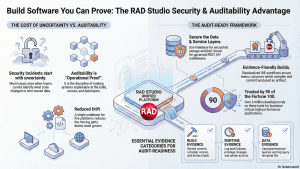

Software auditability requirements engineering teams can implement
Audit-ready software is not created by one feature. It is created by a set of engineering habits that make evidence easy to produce. The practical goal is not perfect reproducibility on day one. The goal is repeatable proof.
Evidence-friendly builds
A trustworthy build process should answer simple questions without drama: which commit produced the build, which compiler and toolchain were used, which dependency versions were pulled in, and which artifact was shipped. Teams should retain build outputs and related metadata for a defined window so they can explain what changed and when.
This is where RAD Studio supports a stronger story than many teams realize. Features such as GetIt package versioning help reduce silent dependency drift by making package selection more explicit. Integrated project management and a mature IDE workflow also make it easier to standardize how builds are produced and reviewed. That does not replace a secure supply-chain process, but it gives developers a cleaner operational foundation for one.
Security event logs with useful context
A security log is only valuable if it supports investigation and, later, introspection. Each important event should capture identity, timestamp, action, outcome, and context. In practice that means recording which user, service, API key, or device initiated the action; when it happened; what operation was attempted; whether it succeeded; and how the request connects to a broader execution path through request IDs, session IDs, or correlation IDs.
Logs become much more useful when they are designed as a product, not an afterthought. Naming conventions should be consistent, fields should be searchable, and event categories should map to the kinds of questions security and operations teams actually ask during an incident.
Access controls that are testable and reviewable
Auditability breaks when access control logic lives in scattered conditionals and undocumented assumptions. A better model is explicit roles and permissions, central enforcement points, automated tests for who can do what, and a clear record of permission changes over time.
This matters for internal systems as much as external ones. In many organizations, internal tools have the broadest permissions and the weakest oversight. Those systems often become the path of least resistance during a breach. A reviewable permission model, backed by logs for privilege changes and access-denied events, closes that gap.
Software auditability: Web and service layers where audit trails often fail
Many audit problems appear at the edges of the system: session handling, authentication, role enforcement, request propagation, and the handoff between the client and the service layer. These are the points where context is often lost.
RAD Studio’s server-side ecosystem helps developers avoid improvisation here. RAD Server provides a turn-key foundation for rapidly building and deploying service-based applications and REST APIs, including authentication-related services and structured middleware patterns. WebBroker and WebStencils keep server-side logic explicit and close to the codebase, which can make request handling and security review more straightforward than in heavily abstracted stacks.
That matters because session creation, privilege changes, authentication failures, access-denied responses, and administrative actions should be treated as first-class security events. When those actions are logged consistently at the service boundary, investigations get faster and access reviews get easier.
Software auditability: Data layer evidence
Your audit story falls apart if you cannot explain data access behavior. Developers should know which query ran, how it was initiated, which tenant or customer context applied, how many rows were affected, and whether the request succeeded or failed.
RAD Studio supports this discipline well because data access is a first-class concern in the platform. FireDAC gives teams a common, high-performance data access layer across multiple databases, which makes it easier to standardize query behavior and logging patterns. The value from an audit perspective is consistency. The fewer custom data paths a team invents, the easier the data layer is to explain and govern.
This is also where secure coding fundamentals still matter. Parameterized queries, explicit enforced input validation, least-privilege database accounts, and careful handling of rejected inputs are not optional. Auditability is strongest when safe data access and visible data access reinforce each other.
Database security foundations with InterBase
The database layer becomes easier to audit when the product itself supports the right primitives. InterBase strengthens the RAD Studio story here, especially for mobile, embedded, and distributed applications that need secure local data storage as well as governed synchronization.
From an audit perspective, encryption at rest and in transit should not be treated as a marketing checkbox. Teams need to show that encryption is enabled, that key handling is defined, that transport security is enforced, and that roles and permissions are applied consistently. InterBase helps make that conversation more concrete with support for encrypted storage, strong transport protections, embedded security capabilities, and change-aware data workflows to make the whole process as succinct and optimized as it can be.
For field and edge scenarios, that matters a great deal. When data is stored locally on devices and later synchronized, the question is not simply whether the app works offline. The real question is whether you can trust the path the data took. That is where secure embedded storage and controlled change tracking become part of the auditability story, not just the performance story.
RAD Studio as a solution platform, not just an IDE
The deeper point is that RAD Studio should be positioned as a solution provider for app developers, not just a coding environment. It gives teams a practical stack for building native clients, connected services, secure data access, and maintainable long-term software with less fragmentation. That combination is what matters when buyers and developers evaluate real delivery risk.
Developers want speed, control, and maintainability. Technical leaders want fewer codebases, lower operational friction, and confidence that the application can be modernized without a rewrite. Security and governance stakeholders want evidence. RAD Studio sits in the middle of those needs unusually well because it supports native performance, broad data connectivity, service development, and long-term code reuse in a single development platform.
In other words, the value proposition is not just to build faster. It is to build software you can defend. Build software that is easier to explain, easier to modernize, and easier to trust.
Practical software auditability: the audit-ready checklist
The most useful auditability work is the work engineering teams can operationalize quickly. The checklist below frames the evidence categories that matter most and the kind of output a disciplined RAD Studio team should be able to generate without last-minute scrambling.
| Evidence Area | What Teams Should Generate Automatically |
| Build evidence | Record commit, compiler version, build runner, artifact hash, and pinned dependency versions. |
| Runtime evidence | Log auth success and failure, privilege changes, access denied events, admin actions, exports, and correlation IDs. |
| Access control evidence | Centralize role checks, test the permission model, and log permission changes like financial transactions. |
| Data access evidence | Use parameterized queries, log query template IDs instead of raw SQL, and obfuscate secrets in logs. |
| Web edge evidence | Track session lifecycle events, enforce output encoding, and make security-relevant request context visible. |
| Encryption evidence | Keep configuration snapshots, transport policy checks, and key-management records for review. |
Software auditability: the positioning takeaway
For developers, the message is clear: RAD Studio helps you build native applications with fewer layers, strong data connectivity, service-side options, and long-term maintainability. For technical buyers, the platform offers a practical path to modernize and extend business applications without multiplying toolchain complexity.
That combination is what makes RAD Studio compelling in this article. It is not simply a way to ship features faster. It is a solution platform that helps teams produce software they can explain under pressure, defend during review, and evolve over time.
Conclusion
Software auditability is one of the clearest ways to connect software engineering practice to security outcomes. If your team cannot prove what code shipped, who had access, what the system did, and how data moved through the application, then your risk is higher than it looks on paper.
RAD Studio gives app developers a strong foundation for closing that software auditability gap. With native cross-platform development, mature data-access tooling, web and service frameworks, RAD Server for connected back ends, and InterBase for secure data handling, it supports a more controlled way to build and run business applications. That is what makes it more than an IDE. It is a platform for building applications that are productive to deliver, practical to govern, and credible under scrutiny.