


The rise of AI in software development is impossible to ignore. New tech that accelerates code generation, suggests smarter refactors, or automates testing promises productivity gains of up to 20% – numbers that naturally excite IT and engineering managers under pressure to “do more with less.”
But there’s a looming danger in how this promise is being interpreted. In many organizations, the response isn’t just to leverage AI. It’s to skip hiring junior developers altogether, betting that AI will fill the gap.
On the surface, the logic seems sound: junior developers are less productive, require mentoring, and add overhead. If AI tools can boost output, why not lean into that instead of expanding headcount at the entry level? The problem is this: AI is not yet that productive. The hype is running ahead of reality. Managers assume AI will reach 20% productivity gain in all applications, but in practice, results vary widely depending on the task, the codebase, and the team’s maturity with AI tools.
The Outsourcing Parallel
We’ve seen this playbook before. Outsourcing became the “industry norm” over the past few decades, especially for lower-level development work. The result? A steep decline in the pipeline of U.S.-based developers. Talent gaps widened. Companies lost control over critical knowledge. And when complex projects required deep institutional context, they were often left scrambling. Now, AI risks accelerating a similar hollowing-out effect. If we skip over the next generation of developers, assuming AI will bridge the gap, we risk eroding the very talent base that makes innovation possible.


The Reality of AI Productivity: The Research
Recent studies show just how far reality is from the hype:
- AI can slow down experienced developers. A 2025 randomized controlled trial by METR found that seasoned open-source developers using advanced AI tools (like Cursor Pro and Claude 3.5/3.7) actually took 19% longer to complete tasks compared to working without AI—even though they felt 20–24% faster. Axios summarized it with the blunt headline: “AI often slowed down their work.”
- Individual gains don’t equal company gains. Faros AI’s 2025 “AI Productivity Paradox Report” showed that while developers might complete 21% more tasks individually, organizational productivity didn’t improve. In fact, code review queues grew by 91%, offsetting the speedup (Faros AI).
- Process inefficiencies outweigh AI time savings. Atlassian’s 2025 Developer Experience Survey found that 99% of developers use AI tools and many report saving over 10 hours per week. But those gains were undercut by organizational friction: inefficient workflows, fragmented tools, and slow communication still drained efficiency (Atlassian).
- Generative AI pilots aren’t yet producing significant value. A recent MIT report suggested that only 5% of enterprise AI pilots have achieved rapid revenue acceleration while the rest deliver little to no measurable impact, often due not to quality but flawed integrations and misapplications.
In short, AI is promising but uneven. It boosts productivity in narrow, well-structured, and entry-level tasks, but it doesn’t yet deliver consistent, systemic gains, especially at the team or enterprise level. And yet, recent studies and surveys show significant declines in junior or early-career software engineer hires since the generative AI era…a trend expected to continue.

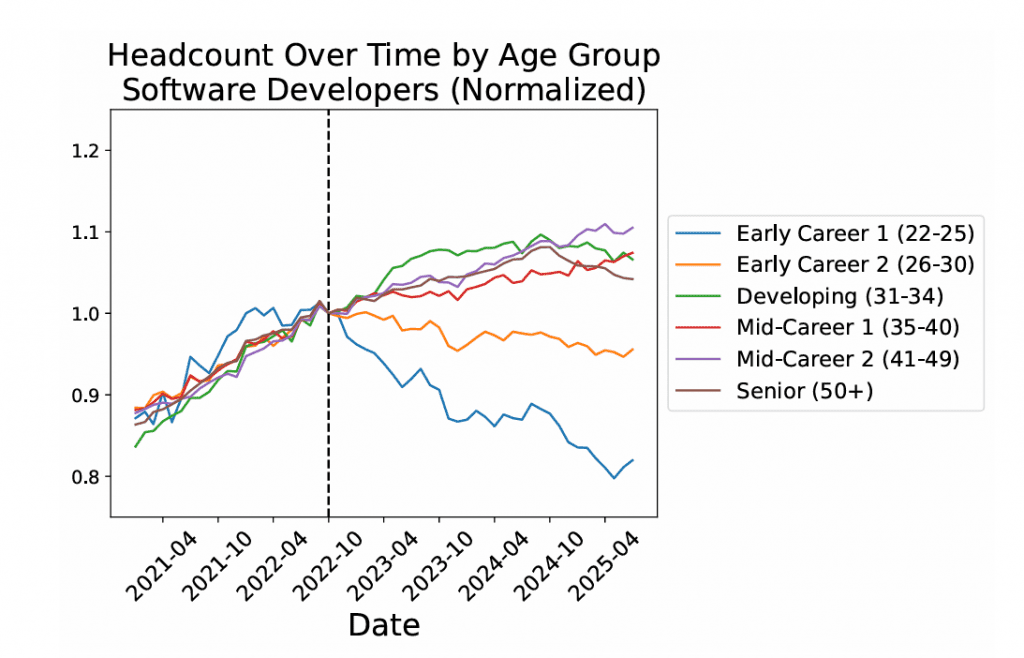
Source: https://digitaleconomy.stanford.edu/wp-content/uploads/2025/08/Canaries_BrynjolfssonChandarChen.pdf
Why Skipping Juniors Is Dangerous
- No pipeline of future seniors.
Today’s juniors are tomorrow’s tech leads, architects, and CTOs. If we cut off their entry point, the leadership bench will dry up in a decade. - Loss of fresh perspectives.
Junior developers bring new thinking, energy, and adaptability that enrich teams. They ask questions that challenge assumptions – something AI cannot replicate.
Systemic risk.
If every company cuts back, the industry as a whole suffers from a shortage of skilled developers later on, just as we saw with outsourcing.
A Smarter Approach
Instead of succumbing to peer pressure and chasing a blanket 20% savings target, IT leaders should:
- Adopt AI where it truly adds value.
Documentation, boilerplate code, simple bug fixes – while maintaining robust human oversight. - Invest in junior developers.
Pair them with AI tools to accelerate learning rather than replace them. - Measure AI’s ROI realistically, not aspirationally.
Treat current tools as accelerators, not replacements. - Resist herd mentality.
Just because competitors claim AI-driven savings doesn’t mean those savings are real or sustainable.


Delphi and RAD Studio Impact
The good news for our community is that we’ve “seen this movie before.” RAD has consistently proven its ability to deliver outsized gains in developer productivity. While Delphi’s niche positioning has limited broader adoption, those who use it know the productivity is unmatched. Delphi teams are often lean – just two or three developers – so a 20% boost in efficiency can make a huge difference with no impact on staffing.
This creates a real opportunity. As more developers grow frustrated with the lack of employment opportunities with mainstream languages, they may increasingly look to alternatives that make building full-stack applications dramatically easier. Imagine a Python developer using RAD Studio to package their app with high-performing native UX – suddenly, they’re unstoppable. AI can accelerate how these pieces are stitched together, but it won’t replace the creativity or expertise of developers. Instead, it amplifies the strengths that RAD Studio and Delphi have embodied for decades.
The Bottom Line
AI is here to stay, and it will make developers more productive. But overselling its impact risks undermining the very foundations of the industry that created it. If IT leaders let peer pressure dictate hiring and training practices, we may create a systemic shortage of experienced developers just as the demand for complex, secure, and innovative software continues to grow. The lesson from outsourcing is clear: short-term gains can create long-term problems. Let’s not repeat the same mistake with AI.